ootdbuy Thermal Base Layer Spreadsheet Guide
ootdbuy Thermal Base Layer Spreadsheet Guide
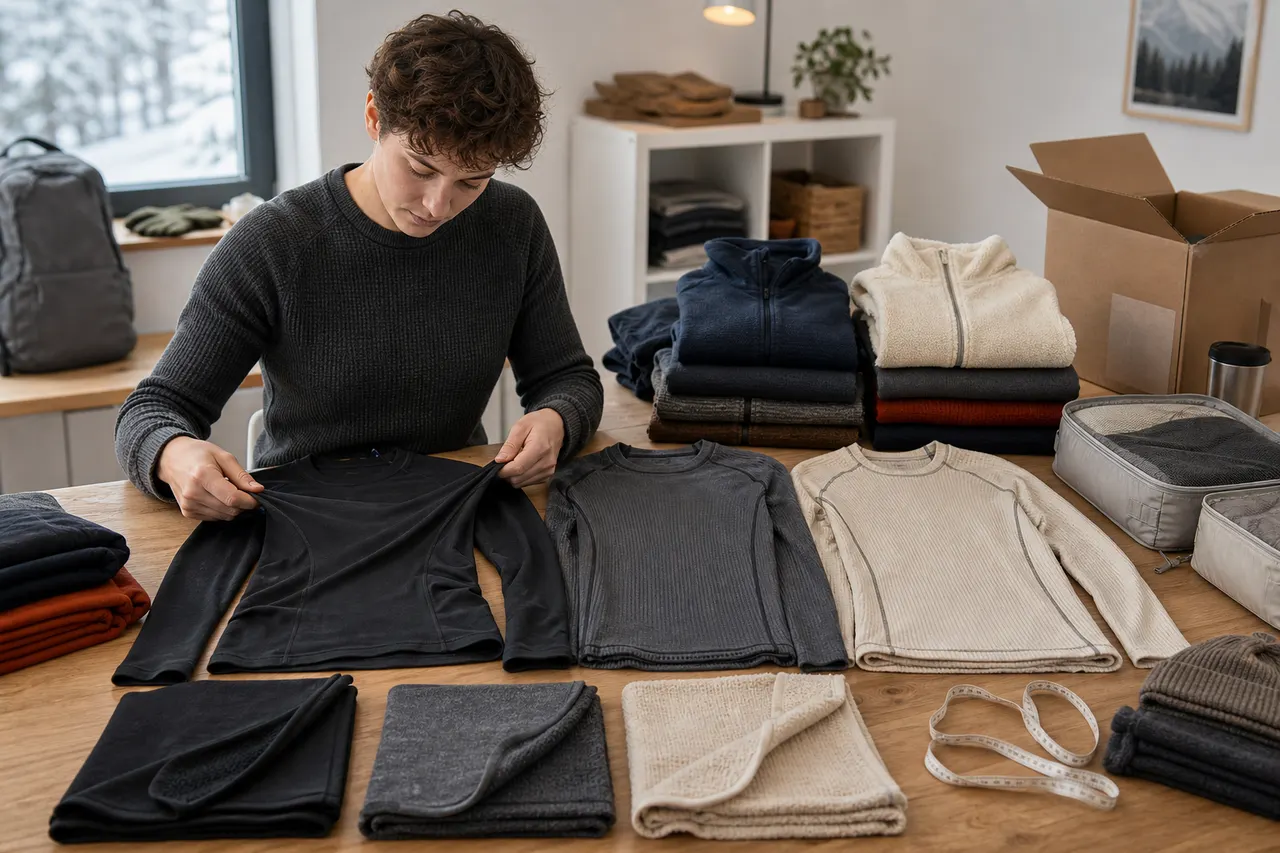
Choosing the wrong thermal base layer doesn't just mean "not warm enough": high-intensity activities can lead to sweat accumulation, a too-tight fit restricts movement, a too-loose fit fails to form a stable base layer, and collars, waistbands, and seams may rub against outer layers. This guide aims to help you use the ootdbuy Spreadsheet to build a candidate list, then use product page information, garment measurements, and QC photos to eliminate unsuitable styles one by one.
This article is suitable for buyers who need to filter base layers for daily commuting, low-temperature static activities, or winter sports. It is not intended for judging extreme cold protection, medical warmth needs, nor can it replace professional outdoor gear's temperature ratings or safety standards. Product inventory, prices, sizes, materials, shipping, return conditions, and page status are all dynamic information; this article does not present them as fixed facts. Before ordering, you should refer to the product page, order page, and platform rules visible on August 27, 2026.
First Determine Activity Intensity, Ambient Temperature, and Wear Duration
Don't start by searching for "thickest" or "warmest". The core task of a thermal base layer is to manage heat and moisture near the base layer, and activity intensity directly changes the requirements.
You can first write down four conditions:
Usage scenario: indoor commuting, outdoor walking, skiing, cycling, camping, or prolonged sitting.
Activity intensity: low, medium, or high. Activities that cause sweating usually prioritize moisture wicking and quick drying over simply increasing thickness.
Exposure conditions: expected temperature, wind, humidity, and whether you can easily go indoors.
Wear duration: short-term use versus all-day continuous wear, which have different requirements for seam friction, waistband pressure, and moisture management.
Usage scenario | Priority checks | Common mistakes |
|---|---|---|
Indoor/outdoor commuting | Thinness, collar concealment, room under outerwear | Only looking at "fleece-lined" descriptions, then overheating indoors |
Low-intensity static activities | Coverage, fit, coordination with mid layers | Treating a single base layer as a complete cold protection system |
High-intensity exercise | Moisture wicking info, seam placement, drying convenience | Choosing overly thick styles, harder to stay comfortable after sweating |
Multi-day travel | Care requirements, replacement frequency, packed size | Ignoring drying conditions and spare base layers |
Temperature should only be a background condition, not the sole determinant of style, as wind, humidity, activity level, and outer protection also matter. Write down your scenario clearly before going into the Spreadsheet to filter; it's more effective than picking by titles from a large number of products. 🌡️
What the ootdbuy Spreadsheet Can Help Filter and What It Cannot Prove
The ootdbuy Spreadsheet is better used as a candidate entry point, not as proof of product authenticity or performance. It can help you view and organize entries centrally, such as product names, categories, marked sizes, visible material descriptions, and corresponding product links; the actual available fields should be based on the current spreadsheet.
The Spreadsheet can help with:
Narrowing down by tops, bottoms, sets, and marked sizes.
Recording page information for different candidates to avoid repeatedly opening the same entry.
Marking products that lack garment measurements, material labels, or key images.
Submitting candidates for subsequent purchase page and QC photo verification.
It cannot alone prove:
Actual warmth or applicable temperature.
Fabric composition, weight, and fiber ratio exactly matching the title description.
Product definitely in stock, or current price, color, and size still valid.
Brand, authorization, authenticity, or seller reliability.
Arrived item free of color difference, stains, wrong size, damage, or sewing issues.
If there are discrepancies between the spreadsheet entry and the product page, you should re-check with the still-accessible product page and order options before checkout, and save key page information. Entries with invalid pages, redirects to unrelated products, only vague titles, or lacking basic specifications should not continue to be included in the candidate list.
Build Candidate Lists by Tops, Bottoms, and Sets
First create three groups for tops, bottoms, and sets separately; don't assume sets are always more cost-effective or better fitting. The upper and lower body may have different needs for fit, length, and movement space, and the unified sizing of a set may not suit all body types.
For tops, record key points:
Neckline type and collar height, to confirm whether it shows under everyday outerwear.
Sleeve length, body length, and chest circumference, especially whether it rides up when raising arms.
Underarm, shoulder, and side seam positions, to judge whether backpack straps or jackets press on the seams.
For bottoms, record key points:
Waist, hip, front and back rise, and inseam.
Waistband width and elastic structure.
Whether the cuffs easily bunch inside socks or boot shafts.
For sets, also confirm whether top and bottom can be selected in different sizes. If the page does not clearly state, do not assume you can mix sizes. Keep three to five candidates with relatively complete information for size and QC comparison; styles lacking key data should be lower priority even if the images look attractive. 🧭
Use Body Measurements and Garment Data to Judge Fit
Body measurements and garment measurements are not the same. Body measurements describe the wearer; garment measurements are the actual data of the product laid flat or measured around. Before comparing, confirm which method the page uses, and whether centimeters and inches are correctly converted.
It is recommended to use a soft tape measure to record chest, waist, hip, shoulder width, sleeve length, inseam, and the length of your usual base layer. When measuring, keep the tape snug but not tight, and use the same measurement points as shown in the page diagrams. If the product page only provides height and weight recommendations without garment measurements, treat it as a low-confidence candidate, not a guarantee of fit.
When judging fit, note:
Snug does not mean tight. Breathing deeply, squatting, and raising arms should not be significantly restricted.
"Stretch" description does not mean equal stretch in all directions.
Measurement error, fabric elasticity, and size changes after washing may affect results.
If the page gives a tolerance, include the tolerance range in boundary judgment, don't just look at nominal numbers.
When between sizes, choose based on activity needs: high activity needs more room for movement, while loose everyday wear should prevent bunching under outer layers.
The most reliable method is to take an existing thermal top or bottom that fits well, measure it flat in the same way as the product page, and compare with candidate garment data. This gives a verifiable reference, rather than guessing size based solely on height and weight. 📏
Check Fabric Labels, Seam Placement, and Layering Space
Descriptions like "fleece-lined", "heat-generating", or "quick-dry" in product titles need further verification, not directly equated with quantifiable performance. Prioritize checking whether the product page provides clear fiber composition, proportions, care labels, inner and outer surface details, and fabric thickness information. If descriptions in different places conflict, confirm with the seller before ordering, rather than choosing the more favorable claim.
Fabric filtering can be done around actual tasks:
Prone to sweating: focus on moisture management, drying conditions, and ease of changing.
Sensitive skin: avoid candidates with unverifiable composition or rough seams, and check neck label and waist label positions.
Need layering: check whether the outer surface easily rubs against mid layers, and whether the length maintains coverage.
Low-intensity sitting: focus on coverage area, neckline and cuff fit, but still rely on mid layers and outer layers for overall warmth.
Seams should be considered together with the equipment used. Shoulder seams may be under backpack straps, side waist seams may be pressed by belts, and inner leg seams add friction during long walks. If the page does not clearly show these areas, list them as must-check items during QC.
The order for checking layering space is base layer, mid layer, outer layer. The thermal base layer should fit close to the body while allowing normal movement; the mid layer provides insulation, and the outer layer handles environmental factors like wind and rain. Don't buy a larger base layer to "leave air" inside, nor use an overly tight style for a seemingly higher warmth feel.
Key Details to Check When Viewing QC Photos
QC photos are used to confirm the visible condition of the arrived item, not to prove touch, long-term durability, or actual warmth. When viewing, match the color, size, and style options from your order with the photos one by one; don't just confirm "looks similar". 🔍
Check area | What to look for in QC photos | Action if information insufficient |
|---|---|---|
Overall front and back | Color, cut, number of pieces, obvious stains or damage | Request full unfolded photos |
Size and care labels | Size code, composition text, care symbols legible | Request close-up label photos and check against order |
Key measurements | Ruler start and end points for chest width, length, sleeve, waist, inseam | Request re-measurement with clear starting points |
Seams and stitches | Skipped stitches, open seams, asymmetry, cuff and hem workmanship | Request close-ups, and if necessary apply for resolution within time limit |
Inner surface | Consistent with page structure, no obvious shedding or defects | If no photos, don't infer material condition |
Measurement photos are only useful if the ruler is straight, start and end points are visible, and the garment is not abnormally stretched. If the photo angle is tilted or the garment is not laid flat, request a re-shoot. For color, consider lighting and screen display differences; don't conclude based on slight color difference alone.
After discovering wrong size, wrong color, missing pieces, or visible defects, save the order options and QC evidence, and raise the issue within the applicable processing period at that time. Do not post complete screenshots containing order number, name, address, phone, or payment information to confirm the product.
Compare Care Difficulty, Packed Volume, and Return Boundaries
Thermal base layers are intimate apparel, so return conditions may be stricter than for regular outerwear, and specific rules vary by seller, product status, warehouse processing stage, and platform policy. Check the current return/exchange instructions on the product page and in the order process before payment; after arrival, pay attention to the operable time limit, and don't directly apply experience from other products.
Care difficulty affects long-term cost. Check whether the care label allows machine washing, water temperature, tumble drying, and whether flat drying is required. If there is only marketing description without clear care information, factor in the confirmation cost. For travel or frequent changes, styles that are hard to dry may be less practical than lighter, easy-to-rotate ones.
Packed volume affects shipping costs, but don't estimate final fees based only on "thin" or "compressible". Combining multiple items may reduce repeated fixed handling or first weight costs, but may also increase package volumetric weight, declared value, and single loss risk; splitting may increase fixed costs but may solve route or size restrictions. Compare options after items arrive at the warehouse and you have actual weight, package dimensions, available routes, and billing rules.
When declaring, truthfully fill in product category, quantity, and value, and prepare taxes and necessary documents according to the destination country's current requirements. Do not request under-declaration, false product names, splitting to avoid taxes, or evading inspection. Route restrictions, taxes, and import requirements are destination- and time-specific; re-verify before submitting the package.
Thermal Base Layer Checklist Before Completing Purchase
Before submitting the order, use the following checklist for a final review:
Written down usage scenario, activity intensity, environmental conditions, and wear duration.
Separated tops, bottoms, and sets, and confirmed whether sets allow separate size selection.
Checked body measurements, garment measurements, units, and measurement methods.
Confirmed color, size, quantity, and product options match the cart.
Checked visible fiber composition, care requirements, neckline, waistband, and seam positions.
Marked sizes, labels, and local workmanship to re-check in QC photos.
Checked current return conditions and post-arrival processing deadlines.
Waited for actual weight and dimensions before deciding on combining, splitting, and shipping route.
Prepared truthful declaration and checked destination country taxes and import restrictions.
Saved necessary page and order evidence while covering personal information.
This filtering method mainly saves the rework costs from wrong sizing, invalid candidate comparison, and lack of information; without current product prices, actual warehouse weights, and available route quotes, it cannot honestly promise specific savings amounts. It adds the time cost of measuring, recording, and requesting QC photos, and cannot eliminate all risks related to fabric touch, long-term durability, and shipping.
This method is most suitable for buyers who need to compare multiple Spreadsheet entries, value fit and layering relationships, and are willing to wait for warehouse evidence before arranging shipping. It is not recommended as extreme cold safety advice, nor for those who must order immediately despite severe lack of information. If the product page cannot confirm basic specifications, sizing method, or return boundaries, the most reasonable decision is usually not to keep guessing, but to remove it from the candidate list. ✅
Browse our latest products and find your next favorite item.